Becoming a great manager

Are you looking to become a manager or leader in your workplace? It’s a great goal to have, but it’s important to remember that becoming a good manager is a continuous and ongoing process. You need to be willing to learn and develop your skills over time.

Communication

Effective communication is one of the most crucial skills for any successful manager. It is essential to be able to clearly articulate your vision, goals, and objectives to your team members. By doing so, you provide them with the necessary information to understand what you are trying to achieve and how they can contribute to your success. Moreover, you need to be a good listener, actively engaging with your team members to understand their needs, concerns, and feedback. Regularly providing feedback and recognition to your team members can help you build stronger relationships with them, while creating a more positive and supportive work environment.

It’s also important to recognize that communication is not just about verbal exchanges. Nonverbal communication, such as body language and tone of voice, can also convey important messages to team members. As a manager, it’s important to be aware of these nonverbal cues and ensure that they convey the right message. Additionally, using a variety of communication methods, such as email, phone calls, video conferencing, and in-person meetings, can help ensure that everyone on your team is informed and engaged.

By prioritizing communication and taking steps to improve your communication skills, you can create a more productive and effective team that is better equipped to achieve your goals and objectives.

Empathy

Empathy is an essential skill that helps managers and leaders to create a positive and supportive work environment. In order to understand the perspectives of team members, you need to be able to communicate effectively and listen actively. This means that you should be willing to take the time to get to know your team members on a personal level and encourage them to share their thoughts and ideas. By doing so, you can build strong relationships with them and create a sense of trust and loyalty that will drive your team’s success.

Furthermore, empathy is not just about understanding others, but also about being able to put yourself in their shoes. This means that you should be able to see things from their perspective and anticipate their needs and concerns. By doing so, you can create a work environment that is not only supportive but also responsive to the needs of your team members.

To develop your empathy skills, there are several things that you can do. Firstly, you should practice active listening and encourage open communication within your team. You should also be willing to give and receive feedback, and use this feedback to improve your own performance as well as that of your team. Additionally, you should make an effort to learn about the different cultures and backgrounds of your team members, and be respectful of their diversity.

In conclusion, empathy is an essential skill for managers and leaders who want to create a positive and supportive work environment. By developing your empathy skills, you can build strong relationships with your team members, create a sense of trust and loyalty, and drive your team’s success.

Delegation

Delegation is a crucial skill for managers and leaders, as it allows them to distribute tasks effectively among team members, freeing them up to focus on more pressing matters. Additionally, it provides team members with the opportunity to develop their own skills and gain valuable experience. When delegating, it’s important to provide clear instructions and expectations so that team members understand what is needed and can work towards shared goals.

Effective delegation involves more than simply assigning tasks; it requires building trust and fostering open communication with team members. This can be achieved by getting to know each team member on a personal level, understanding their strengths and weaknesses, and establishing clear lines of communication. By doing so, managers can ensure that team members feel supported, motivated, and empowered to take ownership of their work.

In addition to improving productivity, delegation can also promote a more positive working environment. When team members feel trusted and valued, they are more likely to take pride in their work and feel a sense of satisfaction when they achieve their goals. This, in turn, can lead to increased morale, stronger team cohesion, and ultimately, greater success for the entire organization.

Continuous Learning

Continuous learning is an essential trait of a successful manager and leader. In today’s rapidly changing world, keeping up-to-date with the latest trends and best practices in your industry is critical. This means investing time and effort into attending conferences, seminars, and training sessions to stay ahead of the curve. Additionally, you should read industry publications, network with colleagues, and seek out mentors who can provide guidance and support.

But it’s not just about staying informed. It’s also important to actively seek feedback from your team members and other colleagues. This can help you identify blind spots in your leadership style, areas where you can improve, and opportunities for professional development. Encouraging a culture of feedback within your team can also help to foster a sense of trust and collaboration.

In short, continuous learning is not just a nice-to-have for managers and leaders – it’s a must-have. By investing in your own development and staying open to feedback, you can become a more effective and inspiring leader for your team.

Vision

A good manager and leader should have a clear vision for their team and organization. This vision should be based on a thorough understanding of the team’s strengths and weaknesses, as well as the challenges and opportunities facing the organization. By taking the time to assess these factors, you can develop a vision that is both realistic and inspiring.

Once you have a vision in place, it’s important to communicate it effectively to your team. This means not only articulating your goals clearly, but also explaining why they matter and how they fit into the bigger picture. By doing this, you can help your team to feel invested in the vision and motivated to work towards it.

But having a vision is only the first step. To be an effective manager and leader, you also need to be willing to adapt your vision as circumstances change. This means staying open to feedback and new information, and being willing to pivot your strategy if needed. By doing this, you can ensure that your vision remains relevant and achievable, even as the world around you changes.

In addition to vision, there are several other key skills that are important for managers and leaders to cultivate. These include empathy, delegation, continuous learning, and effective communication. By focusing on these areas, you can improve your leadership skills and create a positive and productive work environment for your team.

If you’re interested in developing these skills, there are many resources available to help you. Consider taking a course or attending a workshop on leadership, or seek out a mentor who can offer guidance and support. With time and effort, you can become the kind of manager and leader who inspires their team to achieve great things.

10 tips to improve your memory

There are several strategies you can use to improve your memory and retain information more effectively. Here are a few tips that can help:

  1. Pay attention: One of the most important factors in remembering information is paying attention to it in the first place. Try to focus on the information you are learning and eliminate distractions.
  2. Use mnemonic devices: Mnemonic devices are techniques that help you remember information by associating it with something else that is easier to remember. For example, the phrase “Every Good Boy Deserves Fudge” is often used to help people remember the musical notes on the lines of the treble clef (E, G, B, D, F).
  3. Repeat and review: Repeating information and reviewing it periodically can help reinforce it in your memory. Try repeating information out loud or writing it down, and review it at regular intervals.
  4. Use visualization: Visualizing information can help make it more memorable. Try creating mental images or diagrams to help you remember information.
  5. Get plenty of sleep: Sleep is important for memory consolidation, so getting enough sleep can help improve your memory.
  6. Stay physically and mentally active: Engaging in physical and mental activities can help keep your brain healthy and improve your memory. This can include activities such as exercise, puzzles, and learning new things.
  7. Eat a healthy diet: A healthy diet that is rich in fruits, vegetables, and whole grains can help support brain health and improve your memory.
  8. Manage stress: Chronic stress can have negative effects on memory, so it’s important to find ways to manage stress effectively. This can involve techniques such as meditation, deep breathing, or exercise.
  9. Stay organized: Being organized can help you remember things more easily, as you are less likely to misplace important items or forget appointments.
  10. Use memory aids: Memory aids such as calendars, to-do lists, and reminders can help you remember important information and tasks.

Let me know what your tips and tricks are in the comments !

Timers

Timers can be a useful tool for managing your time and staying focused on specific tasks.

To effectively use timers, follow these steps:

  1. Identify the task you want to work on: Before you start using a timer, take a moment to identify the task or project that you want to focus on. This will help you set a realistic time limit for the task and determine how much time you need to allocate to it.
  2. Set a time limit: Once you know what task you want to work on, set a time limit for it. This will help you stay focused and on track, and will prevent you from getting bogged down in the task and wasting time.
  3. Use a timer to track your progress: Start the timer when you begin working on the task, and use it to track your progress. This will help you stay focused and on track, and will allow you to see how much time you have left to complete the task.
  4. Take regular breaks: It’s important to take regular breaks when using a timer to avoid burnout and maintain your focus. For example, you might set a timer for 25 minutes of focused work, followed by a 5-minute break.
  5. Adjust your time limits as needed: Your time limits may need to be adjusted as you gain more experience with the task. For example, if you find that you are consistently completing a task in less time than you had originally planned, you may want to reduce your time limit to keep yourself challenged and engaged.

Overall, effective use of timers can help you stay focused, productive, and on track with your tasks and projects. By setting time limits and using a timer to track your progress, you can make the most of your time and get more done.

Focus Time

Focus time is a specific block of time that is set aside for focused, uninterrupted work on a specific task or project. This can help you be more productive and efficient, as it allows you to fully concentrate on the task at hand without being distracted by other tasks or interruptions.

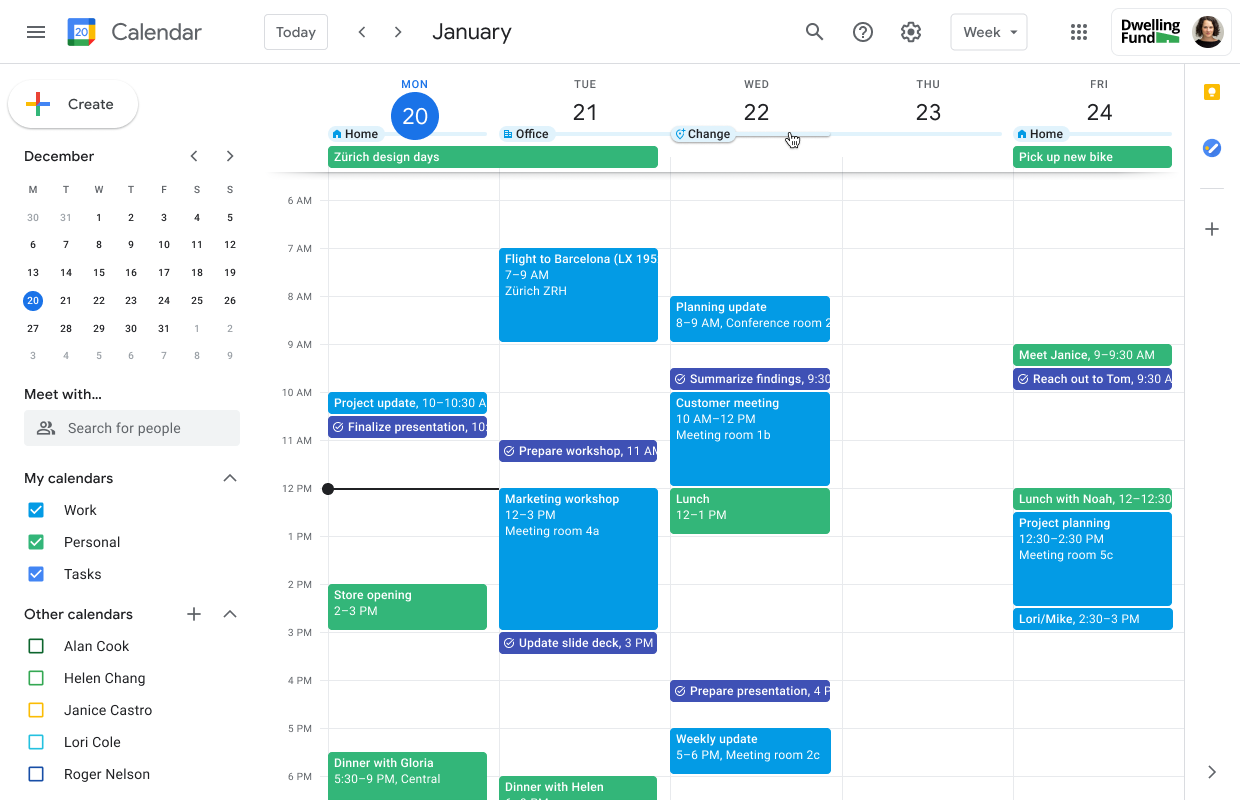
It is often used as part of a time management technique called “time blocking” or “calendar blocking” which involves dividing your day into blocks of time for specific tasks or activities. For example, you might block off two hours every morning for focused work on a major project, and then block off an hour in the afternoon for responding to emails and handling other administrative tasks.

If you are interested in calendar blocking check out my other post specifically on this topic here

Focus time can be helpful for anyone who needs to focus on a specific task or project, such as writers, artists, or professionals who need to work on complex projects. By setting aside dedicated focus time, you can be more productive and get more done in less time.

Calendar Blocking

Calendar blocking is a time management technique that involves setting aside specific blocks of time on your calendar for specific tasks or activities. This can help you stay organized and focused, and can prevent you from overbooking yourself or feeling overwhelmed.

To effectively use calendar blocking, follow these steps:

  1. Identify your priorities and goals: Before you start blocking time on your calendar, take some time to think about your priorities and goals. What tasks or activities are most important to you, and what do you need to do to achieve your goals?
  2. Create blocks of time: Once you know what tasks and activities are most important to you, start creating blocks of time on your calendar for each of them. For example, you might block off two hours every weekday morning for exercise, or one hour every afternoon for writing.
  3. Be specific: When blocking time on your calendar, be as specific as possible. Instead of just blocking off “work time,” for example, specify which projects or tasks you will be working on during that time.
  4. Stick to your blocks: Once you have blocked off time on your calendar, try to stick to those blocks as much as possible. This will help you stay organized and focused, and will prevent you from wasting time on unimportant tasks or activities.
  5. Adjust as needed: Your schedule may change over time, so it’s important to be flexible and adjust your calendar blocks as needed. If you find that a certain block of time is no longer working for you, don’t be afraid to move it or delete it altogether.

Overall, effective use of calendar blocking can help you stay organized, focused, and productive. By blocking off specific blocks of time for your most important tasks and activities, you can make the most of your time and achieve your goals.

Making the most out of your Task Management

  1. Which rules should you follow ?
  2. Choosing the right tasks
  3. Uncluttering your TMS

TMS Ground rules

There are simple rules to follow if you want to make the most out of using a Task Management System. 

First of all, you need it to be quickly available

Like most of the tools you might want to use and put in place, the most important thing is to remove any friction from using them. The easier they are to start to use, the more useful these tools become and more importantly, the more likely you will be to use them.

Additionally, by having a quick access to your TMS, you’ll be able to keep your mind focused on the work or discussion you are having instead of focusing on reminding yourself of the task you’ll need to do later on. 

Lastly, when your TMS is ready at any point in time you can more easily get to the next task with ease. It just means being more efficient on your task switching, really 🙂

Second you need it to feel simple

Continuing the idea of bringing the friction level down, the tool you set up and use must definitely feel simple. The key word here is feel. You might have to come up with a complex structure to keep your life and work organized or separate tasks by projects or clients. The way you structure your tasks doesn’t need to be simple at its core or to the outside eye, but for YOU it needs to make sense and to feel simple. 

Add all the complexity you need, but streamline the process needed to add task in the right section as much as possible. 

Lastly you need it to be persistent

One thing you need for your TMS set up is trust. You need to be sure that the tasks you have to do are in the system and that they won’t leave for any reason unless you want them to. 

Most people start their TMS systems with either post-it notes, a blank sheet of paper or a notepad. For a lot of reasons, this first choice is good, these are easy to use physical objects people can use. However, when it comes to persistence, these tools are on the lower end of it. Post-it notes are mostly stuck to your screen or desk/wall, blank sheets of paper are loose and can get trashed easily and notepads aren’t searchable in the long run. 

Persistence of your tools over time and in your physical space allows you to transform your system into a very powerful tool. You’ll be able to both trust the tool you are using over time and also rely on it at any given time. You’ll want to make sure this tool is always with you and can handle the stress of time. 

Choosing the right tasks

With any tool you set up or use, the one thing that can go wrong is how you use it. Therefore, like any tool, you first need to make sure that you know how to use it properly. 

The primary pitfall with any task management system is to add too many tasks that will just overwhelm you when trying to figure out what to start with or to do. 

Here are some simple rules to make sure you use the right tasks at the right time:

Start with the difficult tasks and the boring tasks first. 

Why start with the difficult tasks : the difficult tasks will most probably need most of your brain power and your attention. Therefore these should be the first one to choose when selecting the tasks you need to focus on. 

After the difficult tasks, the best is to focus your attention based on the following methods.

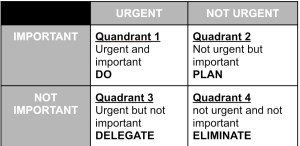
Eisenhower Matrix

This matrix allows to structure your decision making into 4 quadrants. Each quadrant gives you a clear view of when and if you should take a task into your todo list:

Eisenhower Matrix

2 minute rule

The two minute rule is simple really, whenever a task takes 2 minutes or less, you should do it straight away. This will unclutter your mind and allow you to focus on the rest of the Eisenhower matrix.

Boring task first

As long as the task fall into one of the Eisenhower matrix fields you will target (quadrant 1) and is boring, you should follow with that one first. 

Uncluttering your TMS

One last step to get the most out of your system is to make it last as long as possible. There is nothing worse than a system you work on but end up quitting because it’s a mess. Therefore, you need to learn to unclutter your TMS. Here are some simple rules to follow:

  1. Create an inbox / task dump location in your TMS. You are not going to be able to work on all tasks at once and new tasks shouldn’t take space in your current tasks. 
  2. Choose a limited number of tasks from your task inbox every day / half day to work on following the steps mentioned in the previous segment. 
  3. Remove all untouched tasks or use an automatic removal for tasks you haven’t done that day from your current tasks. This will help you plan the next day more easily 
  4. Repeat 

Following the above steps will definitely help you make the most out of any Task management system you build for yourself.

Why you need a Task Management System

Most people think that a task management system is overkill and or totally unnecessary. But the truth is that nowadays it has become a prerequisite for any work but also for your daily life. 

Key needs for a Task Management system : 

  1. Reliable source for all your todos
  2. Reminders and accountability 
  3. Achievement and purpose

Reliable source for all your todos

The main reason why you should consider a task management system is to build a efficient and reliable way to follow everything you need to do. Essentially, you are providing yourself an assistant that will record information for you and feed it back to you when you need it. Additionally, this system should help you in deciding which task you should prioritize. 

You might think that you don’t need such a system and that your mind is enough for everything you need to do. Sometimes you might be right, but sometimes it is not good enough. What you need is consistency

Having a reliable source for your tasks buys you something that is becoming pretty much priceless nowadays : peace of mind. However in order to have this peace of mind you need to make sure your system is secure and available at any time. 


reliability

/rɪlʌɪəˈbɪlɪti/

noun

the quality of being trustworthy or of performing consistently well.

“the car’s background gives me every confidence in its reliability”

the degree to which the result of a measurement, calculation, or specification can be depended on to be accurate.

plural noun: reliabilities

“these data throw doubt on the reliability of national statistics”


What you are seeking with a task management system is to make sure you have a safe space you are confident will contain both the right information and that over time you will be able to find it there consistently. 

This reliability is exactly what makes such a system powerful. 

Why is reliability so important ?

In the past few years productivity has become a growing topic on the internet but most views are the same: achieve more by keeping tabs on what you need to do. 

The truth is that we need predictability in our lives to be able to use our brain power for something else. Therefore, the more automation or reliable tools you use, the less you need to worry about and the more you can focus on the things you actually want to do. 

Reminders and accountability 

This is actually one of the most important parts of the system you are trying to build.

A task management system is a tool that needs to serve you but it should also help you when you need it most. This tool should help you when you are your worst self: forgetful and / or lazy 🙂

The reason why reminders are so useful and powerful is because they are an efficient way to relax our brain. Reminders allow you to be forgetful without fearing the consequences. Whenever you have something to do but don’t use a reminder, you are asking your brain to store the information and check if the time has come every minute, day, month. Even if you are not consciously doing it it still takes brain processing power away from you. This power you could use to think about new ideas or even spend time talking to someone 🙂

Additionally, what you need for anything good to come out of this type of tool, is accountability. You want to make yourself accountable for the things you do. The reason to make yourself accountable is for you to be aware of the things you can and cannot do. There is a simple way of thinking about accountability: it’s not supervision. It’s empowerment. Knowing what you are able to do in a given amount of time allows you to know either the limits you want to keep or the ones you want to push forward and improve. 

Achievement and purpose

Our brains have evolved but not as much as you would expect. They actually rely heavily on instant gratification. A prime example of this is sugar. When eating sugar, our brains light up because it knows that this sugar will bring energy rapidly to our system. It’s a response learned over the course of our evolution and hasn’t changed even though the availability of sugar has gone up for us as a species. There are ways for us to use this to our advantage when trying to complete a task or reach our goals. 

This is where gamification comes in: 


Gamification is the strategic attempt to enhance systems, services, organisations and activities in order to create similar experiences to those experienced when playing games in order to motivate and engage users.


We are wired to be motivated by actions that bring us joy/pleasure or simply rewards us. It is therefore in our best interest to make sure our tasks bring us a sense of reward. For some people gratification comes from throwing away a post-it note, or crossing an item off a list. These small actions are the ones that we are pursuing when actually working on the lists we create. 

The reason task management systems are so beneficial is that they allow you to treat any project or todo list as a game. You create a new game and you go through the level (the actual work) and when done, you have completed the level and the system shows how good you are at the game you’ve created by the number of todo’s you’ve done in a day. This system then gives your brain the sensation that your work has achieved something meaningful for you. 

Having a sense of achievement for anything you have to do, even if it’s boring or difficult, is what you are creating when you are using a task management system. 

Apart from the sense of achievement. A greater goal or need we have is actually to have a sense of purpose. Purpose is our great driving force as human beings. Without it motivation goes down and even health might take a hit. 

Our minds and will are driven by this sense that we are not doing things for nothing. That there is meaning in our work and life. (Probably the reason religion works so well…). 

Our task management system should allow us to link our work with our sense of purpose. If you are working to provide to your family, then every task you complete should bring you one step closer to it. (If it does not, then is that task really worth it ?)

A system allows you to bring your purpose and your daily tasks closer to each other. Creating a good system should allow you to know IF you should do a task, WHY you are doing a task, WHEN you should do it compared to other tasks and give you a sense of ACHIEVEMENT towards goals you have.